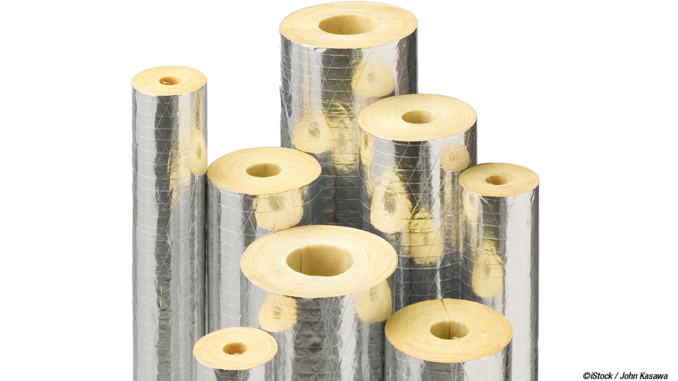
Reports earlier this year that drywall at Vancouver’s Millenium Village was going up over uninsulated mechanical pipes garnered widespread attention because of the venue’s Olympic significance. But according to some insulation contractors, this problem is far more prominent than that.
Andre Pachon, owner of C & G Insulation in Kelowna says if he didn’t stop it, walls would go up over uninsulated pipes as often as every third job. When the issue arises, Pachon insists the insulation go on chilled water pipes 100 percent of the time, and on hot pipes he just informs the general and lets them decide.
C & G was hired to install firestopping in a school two winters ago, and Pachon asked for heat in the building, which is required for firestopping to be effective. His request wasn’t met. Pachon told the general contractor that the firestopping wouldn’t go in until the building was heated, so the drywall went up without it.
“I told the general the walls would have to come down, and that I wouldn’t be signing off the firestopping until they did,” said Pachon. “The general said, ‘Yeah, yeah, we’ll take it down,’ but the next time I checked the drywall was being taped.”
Pachon documented what he saw and repeated his concern. When he saw paint going on the walls, he threatened to call the architect and engineer. “After that they finally took the board down and let us work,” said Pachon.
C & G is currently working on highrise residential job where the walls had to come off so chilled water pipes could be insulated. “That happened yesterday,” says Pachon.
Ceiling grid also goes up over untested pipes, which means insulators have to work through the grid, he adds.
He relates the problem to more drywallers working on piece work. “[Drywallers] work long hours and come in on weekends just to try to make ends meet. There’s no controlling these guys.”
A flawed scheduling system that lumps time for mechanical insulation in with the mechanical contractor’s time is also to blame, said Pachon, adding that the problem begins with architects and building owners expecting construction to move on tighter deadlines that save money. Holding drywallers back until pipes, electrical work, and insulation are finished would improve the situation, as would paying them an hourly wage, says Pachon.
The problem leaves a big question mark hanging over whether these projects are adequately inspected. Pachon said he assumes they are, but adds that like many others in the construction industry, inspectors are younger now, and might be less-skilled and “easier to push around.”
Brad Haysom, owner of Tight 5 Contracting Ltd. in Burnaby says his company has also experienced the problem. “It really throws a wrench into our plans because we’ll hear the board is going up tomorrow and we have to pull guys off other jobs to get the pipes done,” he says.
Haysom says that, like Pachon, he won’t allow walls to go up over uninsulated pipes, but that is the only thing that prevents it from happening regularly. “We’d kick the walls in to get the insulation in there,” said Haysom.
It generally happens more on residential highrises where the company also works through the ceiling grid at least 50 percent of the time.
The problem isn’t isolated to B.C. Richard Plue, owner of True North Insulation in Waterloo, ON says his company is pushed by an unrealistic schedule 50 percent of the time, and that half of his ceiling jobs are completed working through the grid.
It isn’t often a wall goes up without insulation, because like the others Plue won’t allow it, but this often means rushing the job. “I’ve had jobs where I’m given an hour’s notice to get the insulation on.”
True North Insulation does mostly commercial and institutional work. In hospitals, working through a ceiling grid is especially difficult. “You generally have to insulate both supply and return ducts, and plumbing, heating, and cooling pipes in a hospital so it’s already a really difficult application,” said Plue.
Being included in an integrated design process or at least consulting subtrades during scheduling might help resolve the issue, said Plue. “We aren’t even considered. Once the roof is done the duct and mechanical systems go in and while that is happening the partitions are built ... which doesn’t leave a lot of room for us.”
Eric Brown, is manager of Sunco Drywall’s Surrey location, a company that has not been implicated in closing walls over uninsulated pipes. Brown says the company runs with the general contractor’s schedule, and that it’s unfair to put the onus on his trade to manage another subtrade’s contract.
“It’s the GC’s responsibility to practise due diligence and to get everything inspected before giving us the okay to board,” he says. “If someone else doesn’t do their work in the scheduled time and we are told the job is inspected then we assume it is.”
Sunco does a pre-check and brings up any concerns it may have to the general, but Brown notes his crewmen are not plumbers, and don’t always know what pipes are or should be done.
“We have a general idea about what the finished work should look like, and we will refuse to board if the work isn’t complete.”
Murray Corey, executive director for the British Columbia Wall and Ceiling Association says ideally, the drywall contractor wouldn’t get the go-ahead to close in a wall which contained utilities or other required services until all required inspections were completed. However, the general contractor may order the drywall contractor to commernce boarding prior to some items being completed.
There are trade sequence challenges on any job, he adds. “One trade may be unable to show up with materials or manpower when required, which then delays all the others. In today’s fast-paced construction world the actual details and drawings for some aspects of the project may not even be on the job site when needed so sometimes you just don’t know what else is happening with other trades.”
Corey said the responsibility falls to the GC to conduct all trades planning meetings to try to avoid such occurrences. “Hopefully now that the pace of building projects has slowed down somewhat that such issues will not be as common as they were in the past few years.”
The British Columbia Insulation Contractors’ Association (BCICA) and Thermal Insulation Association of Canada (TIAC) are set to present the details of the problem at lunch and learn sessions with architects’ and engineers’ associations.
Five major Canadian general contractors were contacted, but did not respond to interview requests. JK